Easter ~ Eostre ~ Ishtar
A choice of accepting Fact, a Blended Reality or Complete Mistruth


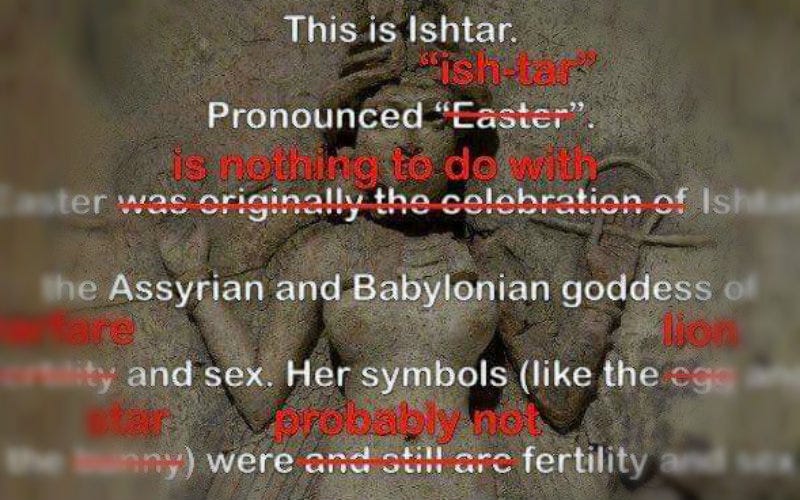
It is that time of the year again when an increasing about of mistruths tend to emerge with respect to the "truth" about Easter ~ the most annoying one (at least for me) is the assertion that Easter originated from the ancient Babylonian (Assyrian) Goddess Ishtar.
This falsehood continues to do the rounds within pagan and neo-witchie circles despite endless attempts of fact checking, pointing out the errors and even the origin source as to where such an erroneous statement originated. But alas to no avail.
Another asserted "truth" is the connection with a lesser known Anglo-Saxon Goddess Eostre, an alternative name today used for the spring equinox. Such recorded origins stems from the writings of the Venerable Bede, a prolific English monk and scholar, who recorded:
“Eostremonath has a name which is now translated Paschal month, and which was once called after a goddess of theirs named Eostre, in whose honour feasts were celebrated in that month. Now they designate that Paschal season by her name, calling the joys of the new rite by the time-honoured name of the old observance.”
(Bede, De temporum ratione, XV)
It is always nice to have a hard, cold fact to justify one’s belief, especially in our scientifically driven modern world where “proof” and “fact” automatically equates to “truth”. Yet, unfortunately, there will come times when the veils of a perceived reality are drawn back to reveal something different.
I recently came across this article which indicating that some scholars actually suspect that the Venerable Bede really did not have a clue about what the Anglo-Saxon “Eostremonath” meant, and as such, he simply invented an “Eostre” goddess to explain the obscure name.
If reading is not your thing, then there is a video 👇
Regardless of whether you agree with what Tim O’Neill (History for Atheists) discusses in either his article or video, one thing that it highlights, at least for me, is the increasing importance to check and recheck facts - even those from allegedly historical sources.
In my own book Dancing the Sacred Wheel, I mention the writings of the Benedictine monk, as well as making reference to Professor Ronald Hutton’s Stations of the Sun (Oxford University Press, 1996) being my own source.
Does this mean that both myself and the good professor were duped by the misunderstanding of Bede?
Possibly.
Does this mean that we should “throw the baby out with the bathwater”, so to speak, and adapt the truth (the whole truth and nothing but the truth?
To this I would personally disagree, and my reasoning is as follows (which seems to push the boundary of my somewhat logical mind).
Truth, and even “fact”, is based on perception of reality, and everyone’s perception on reality is determined by a multitude of things that maybe I will write about at another time. However, things are not always as they may appear to be, as with the following image of stairs.
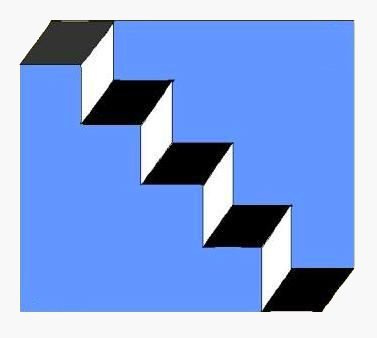
When you focus on the picture, they will begin to change direction every few seconds. It is something that the brain, our perception or conscious reality, cannot prevent.
Was Bede correct in his assertion that there was an Anglo-Saxon Goddess named Eostre, or is criticism coming from a different perspective?
As I am not a historian, I take the view as to how does this “fact” or “truth” affect me and how I relate to not only the spring, or vernal, equinox as well as Easter.
In all honesty, there is no impact. I refer to the spring equinox as it is ~ I do not even refer to it as “Ostara”, another alternative name. As I reside in the Southern Hemisphere, any association with rabbits, eggs and new life at this time of year (being autumn) has always been out of place.
Added to this, I am also quite comfortable with the “mythic truth” of things, through which sacred symbolism ebbs and flows, dissolving the boundaries and taking us into the liminal spaces of the dreamworld.
I do not always need to hard, cold fact to be proven to me, especially when the “fact” itself can actually never be ascertained as 100% accurate. I mean, I was not around in the 7th century when Bede was. I have no idea of what his motives were, if indeed there were any.
What I do know is that it is so easy to look back at the past with our modern understanding of things and to make all manner of assertions - yet, we are still perceiving things through our own perspective, our own understanding of things, as opposed to what was happening, or how the world was being perceived at that time.
Yet, in saying all of this, there is a difference between Venerable Bede’s “Eostre” as possibly a goddess and any connection between Easter and Ishtar.
At least, from my perspective.
Maybe we all simply need to breathe and over-indulge in chocolate!!